- Venezuela and the ‘Bolivarian Revolution’: Beacon of Hope or Smoke and Mirrors? by Shawn Hattingh (ZACF)
 For many people on the left, within and outside of Southern Africa, the ‘Bolivarian Revolution’ is seen as a beacon of socialist hope in a sea of capitalist despair [1]. The reason why many leftists feel so strongly attached to this project, and promote it as an alternative, is because they have come to view it as a move by the Venezuelan state towards creating a genuine, free form of socialism [2] or at the very least an experiment that profoundly breaks with the tenets of neo-liberalism [3] [4]. Many articles have, therefore, been written lauding the state’s nationalisation of some industries [5], its land distribution programmes [6], and its attempts to supposedly create participatory democracy in workplaces (through co-management and co-operatives) [7] and in communities (through community councils) [8]. Linked to this, a great deal has also been made of the state using some of revenue generated by the Petróleos de Venezuela (PDVSA) to roll out social services such as education, subsidised foodstuffs and healthcare [9]. Much ink has, consequently, been spilt arguing that all of these are socialist inspired moves and passionate calls have been made for other states, like the South African state, to adopt Venezuelan style ‘Socialism for the Twenty First Century’ [10].
Article published April 24, 2012 online on zabalaza.net and anarkismo.net
- Class War and Imperialism in Greece by Shawn Hattingh (ZACF)
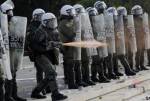 As the crisis in Europe has intensified, class war and imperialism have deepened in Greece. Indeed, the Greek working class has been subjected to further attacks from the local ruling class – comprised of capitalists and high ranking state officials – and imperialist powers. In order to receive the latest ‘bailout’ from the International Monetary Fund (IMF) and European Central Bank (ECB), a bailout that goes straight to the banks that own most of the Greek state’s debt, the Greek state was told by the German, French and US ruling classes to once again reduce pensions by more than 15%, to fully privatise public utilities, to yet again cut social spending, and to implement more wage cuts, including a 22% reduction in the minimum wage. By 2014 it is planned that the Greek state would have cut spending, mostly on social services, by a further 12 billion Euros. All of this has come on the back of earlier rounds of austerity measures and the Greek working class has been under severe pressure: homelessness has been growing at a rapid rate and the unemployment rate has shot past 20%.
Article published in April 12, 2012 analysing the crisis in Greece and Europe
- The 2012 Budget: by the Ruling Class for the Ruling Class by Shawn Hattingh (ZACF)
 Once again much media fanfare has broken out in aftermath of the South African state’s budget speech. The budget, however, is yet more proof of the ANC’s ruling class agenda: free markets, budget cuts for the poor and subsidies for the rich. From the budget and other utterances it is clear the ANC has, despite media hysteria, no interest in nationalisation. The state will, therefore, try and deal with the global economic crisis largely through business-as-usual.
The business media, however, has fallen all over itself with the news, from the budget, that the state will be spending billions of Rands on infrastructure and the development of ‘Special Economic Zones’, supposedly to create employment and help the poor to find a job. Much too has been made of the state spending over 50% of the budget on social services. Messages, from the state and the private media, and from the party leaders of the SACP and ANC, have been about how the budget is intended to help the poor and drive job creation. The Minister of Finance, Pravin Gordhan, has been presented as giving hope to the dispossessed, and as giving a helping hand to the most marginal sections of society through the budget. Since, however, the budget does nothing to remove the causes of poverty, the welfare part of the budget is in reality about providing tiny grants and propping up crumbling state hospitals and township schools.
Article written analysing the State budget speech published on 2 March 2012
- Bourgeois Nationalists are Destabilising the Working Class in South Africa by Jonathan Payn (ZACF)
Anarchism is an idea that stands for the reorganisation of society and the economy in order to meet peoples’ needs and not for profit, according to the principle, ‘from each according to ability to each according to need’. It stands for a world in which there are no longer bosses and workers, masters and slaves; a world in which everyone is a free worker, and exploitation and oppression have been abolished…
Article first published in Zabalaza News, issue 4. Dated October 2011. Download the PDF of that issue here
- Zabalaza: A Voice for Organised Anarchism in South Africa by Jonathan Payn (ZACF)
The Zabalaza Anarchist Communist Front, or ZACF – Zabalaza meaning ‘struggle’ in isiZulu and isiXhosa – is a specific anarchist political organisation based in Johannesburg, South Africa. It is a unitary organisation – or federation of individuals, as opposed to a federation of collectives – whereby membership is on an individual basis, by invitation only. This is because we have seen – through our own experience, as well as that of global anarchism historically – that we can accomplish more as an organisation, and be more effective, when our members share a certain level of theoretical and strategic unity, and collective responsibility.
Article published in the CNT periodical. Dated 6 November, 2011. Download the PDF of that issue here
- Cleaning out super-exploitation by James Pendlebury (ZACF)
How can the most harshly exploited workers fight back against the bosses?
Cleaning workers throughout South Africa have been on strike since Monday 8 August. They are demanding a living wage of R4 200 per month, as well as a 13th cheque and shorter hours.
Many of these workers are now paid R2 000 per month or even less, and work under the harshest conditions. The vast majority are black, and a great many are women; their supervisors are often racist and sexist bullies of the worst kind. They are frequently compelled to use dangerous chemicals, without even the protection of gloves; these chemicals can make them sick, and some have died as a result.
Dated 14 September, 2011
- Anarchist Economics (a Brief Introduction) by Warren McGregor (ZACF)
Comrades, this presentation covers the themes of global redistribution, economic growth of a new type, and renumeration and what these may mean in an economy based on anarchist principles. I was mandated to examine how these themes related to the two required readings for this week:
(i) Read’s Kropotkin: Selections from his Works, and
(ii) Albert’s Parecon
First published on Anarkismo.net. Dated 05 September, 2011
- All GEARed Up for a New Growth Path – On the Road to Nowhere by Shawn Hattingh (ZACF)
It has become common knowledge that South Africa is the most unequal country in the world. Only 41% of people of working age are employed, while half of the people employed earn less than R 2 500 a month. Worse still, inequality is growing with wages as a share of the national income dropping from 50% in 1994 to 45% in 2009; while profit as a share of national income has soared from 40% to 45%. In real terms this means that while a minority live well – and have luxurious houses, swimming pools, businesses, investments, and cushy positions in the state – the majority of people live in shacks or tiny breezeblock dwellings, are surrounded by squalor, and struggle on a daily basis to acquire the basics of life like food and water. Likewise, while bosses, state managers, and politicians – both black and white – get to strut around in fancy suits barking orders; the majority of people are expected to bow down, do as told, and swallow their pride…
First published online on this site. Dated 13 July, 2011
When we celebrate May Day we seldom know or reflect on why it is a holiday in South Africa and in many parts of the world. Sian Byrne, Warren McGregor and Lucien van der Walt tell the story of powerful struggles that lie behind its existence and of the organisations that both created it and kept its meaning alive.
Faced with neo-liberal globalisation, the broad working class movement is being forced to globalise-from-below. Working class internationalism is nothing new; we need to learn from the past.
First published in the South African Labour Bulletin (SALB) Vol 35 Number 1 Mar/Apr 2011. Dated 25 April, 2011. Download PDF leaflet here
- Counterpower, Participatory Democracy, Revolutionary Defence: Debating Black Flame, Revolutionary Anarchism and Historical Marxism by Lucien van der Walt
This article responds to criticisms of the broad anarchist tradition in International Socialism, an International Socialist Tendency (IST) journal. It discusses topics such as the use of sources, defending revolutions and freedom, the Spanish anarchists, anarchism and democracy, the historical role of Marxism, and the Russian Revolution.
Published on Anarkismo.net. Dated 9 April, 2011
- Take Back What’s Yours: the Mine-Line Occupation by Shawn Hattingh (ZACF)
The economic crisis in South Africa has seen inequalities, and the forced misery of the working class, grow. The workers at Mine-Line show the way forward.
Published on Anarkismo.net. Dated 7 April, 2011
- The Kronstadt Rebellion: Still Significant 90 Years On by Shawn Hattingh (ZACF)
Article written to commemorate the 90th Anniversary of the end of the brutal suppression of the Kronstadt uprising, 18th March 1921 – 18th March 2011
Published on Anarkismo.net. Download PDF pamphlet here
For any person who has hung around anarchists long enough, you must of heard us ranting on about how “parliament is not a means of stuggle” because “people who get their asses into parliament and all the money and power start to only worry about getting more money and power” or “society is run from the board rooms of the giant companies who control the economy and NOT by a bunch of liars sitting comfortably in Parliament” etc. etc. These people feed us a whole bunch of lies to get themselves elected and then for the next couple of years sit comfortably and do nothing about anything of relevance to us (except maybe how to get more money or labour out of us). Emma Goldman speaking about her time in Russia during the revolution had this to say about the “revolutionary government” of the Bolsheviks: “Government, whatever its form or pretences, is a dead weight that paralyses the free spirit and activities of the masses.”
Published on Anarkismo.net. Dated 19 August, 2005
Recently, much debate has been generated in South Africa by the announcement by the Congress of South African Trade Unions (COSATU) that it was launching a campaign against joblessness and poverty with a “united front” similar to the united democratic front that fought apartheid in the 1980s – and which was unilaterally disbanded by the now-ruling African National Congress (ANC) in 1990 because of its potential to pit the grassroots against the emerging ANC elite.
Published on Anarkismo.net. Dated 12 August, 2005
The article is a response by the Zabalaza Anarchist Communist Federation (ZACF) of southern Africa to an article by Saul Newman entitled “Anarchism and the Politics of Ressentiment” which is online here.
Written by Michael Schmidt and published online, 9 October 2003
Published in the first issue of Against War and Terrorism in October 2001, which was compiled by an international group of anarchists just after the September 11th 2001 attack on the World Trade Centre
Read the full pamphlet here and the second edition here
Italian translation is here
Published in Red & Black Revolution #5, May 2001 (Ireland)
Published in Black Flag, 1998 (Britain)
Published in Red & Black Revolution, 1998 (Ireland)
Published in Le Monde Libertaire, 1997 (France)
 zabalaza.net